
GM OAMI Supplier Automation Standards and the Industry 4.0 Shift
General Motors' Overall Automation Maturity Index (OAMI) gives automotive suppliers a formal way to benchmark automation maturity across their manufacturing operations. As of September 2026, GM is the only major automaker publicly reported to use a dedicated supplier automation-maturity index of this kind. Ford, Stellantis and other OEMs have not announced direct OAMI equivalents.
That does not mean GM is alone in pushing its supply chain toward greater digital maturity. Other automakers already use supplier assessments, quality scorecards, data-exchange requirements and Tier-N flow-down processes that can influence how suppliers operate. BMW, for example, has made Catena-X registration part of its procurement process, while Ford and Stellantis maintain established supplier assessment and quality frameworks.
OAMI, therefore, matters beyond GM. It shows how Industry 4.0 concepts such as connected equipment, manufacturing data integration, MES connectivity and smart factory maturity can become more visible within supplier relationships.
TL;DR
GM is currently the only major automaker with a publicly reported supplier automation-maturity index.
Ford and Stellantis have not announced OAMI equivalents, although both already have supplier assessment and quality frameworks through which additional digital manufacturing expectations could eventually be addressed.
Industry 4.0 maturity can also be evaluated using established frameworks such as the acatech Industrie 4.0 Maturity Index, SIRI and the MESA MOM Capability Maturity Model.
Tier 1 suppliers should not treat OAMI as an official scoring system for their Tier 2 suppliers. GM has not publicly instructed Tier 1s to cascade OAMI in that way.
Tier 1s can still use similar maturity concepts to evaluate whether Tier 2 suppliers have the connectivity, production visibility, traceability and system integration needed to participate in a more digitally connected automotive supply chain.
OAMI Reflects GM's Industry 4.0 Direction
OAMI provides GM with a common supplier benchmark for understanding automation maturity at a time when automotive manufacturing is becoming increasingly connected, data-driven, and software-enabled.
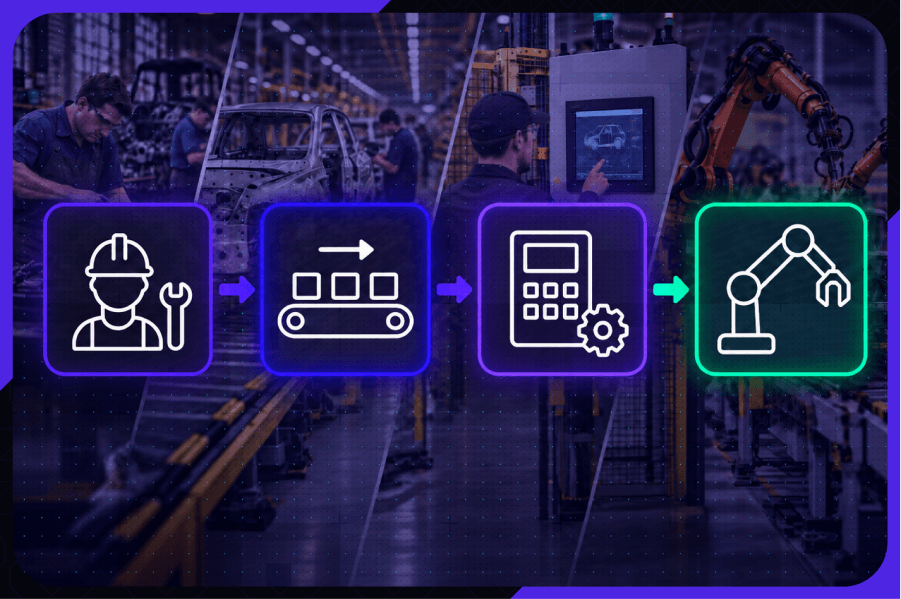
The reported five-level OAMI progression begins with manual production and moves through mechanization and semiautomation toward integrated automation and the smart factory. GM has not publicly released the detailed scoring rubric behind those levels, so specific technologies should not be treated as guaranteed requirements for a particular score.
The overall direction, however, aligns closely with broader Industry 4.0 priorities. More mature manufacturing environments typically connect equipment to manufacturing software, make production data available in real time, coordinate information across quality, maintenance and inventory systems, and use that information to support faster operational decisions.
That emphasis is also consistent with GM's own manufacturing technology direction. GM has been developing a more connected MES architecture and investing in technologies such as digital twins, factory simulation, robotics and AI. The connection between those internal initiatives and OAMI has not been formally stated by GM, so they are better viewed as part of the wider manufacturing context rather than the stated cause of OAMI.
For suppliers, the broader implication is that automation maturity increasingly encompasses how effectively equipment, software, and production data work together. Fuuz's existing OAMI guidance identifies capabilities such as data accessibility, contextualization, system integration, closed-loop operations, and scalable digital infrastructure as indicators of greater manufacturing maturity.
GM OAMI vs. Stellantis Digital Manufacturing Standards
GM and Stellantis both place structured expectations on suppliers, but their publicly documented approaches currently address different aspects of supplier performance.
GM OAMI is a supplier-facing automation maturity benchmark. Suppliers reportedly assess their operations against a maturity progression covering automation and digital integration across the manufacturing value chain.
Stellantis has not published an equivalent automation-maturity index. Its public supplier framework is built primarily around quality requirements, performance management and compliance with automotive quality systems.
Stellantis's Quality Requirements for Suppliers are linked to its IATF 16949 customer-specific requirements. These requirements also demonstrate an important supply chain mechanism: Tier 1 suppliers are expected to manage sub-tier suppliers to ensure that relevant Stellantis requirements are carried through the supply chain. A published Tier 1 flow-down document, for example, requires suppliers to manage Tier N and obtain compliance from sub-suppliers.
That creates an important distinction between the two OEM approaches:
Area |
GM OAMI |
Stellantis supplier framework |
Primary Focus |
Automation and manufacturing maturity |
Quality, compliance and supplier performance |
Supplier Maturity Score |
Reported five-level OAMI scale |
No public automation-maturity scale identified |
Supplier Assessments |
OAMI self-assessment with possible further review |
Quality and supplier-performance processes |
Sub-tier Flow-down |
No public evidence of a formal OAMI cascade |
Explicit Tier-N requirement flow-down |
Digital Manufacturing |
Incorporated into OAMI maturity concepts |
Separate from the publicly documented supplier quality framework |
Stellantis is also advancing digital manufacturing within its own operations. However, its smart factory initiatives and its contractual supplier quality framework should be treated separately unless Stellantis formally connects the two.
Ford and Stellantis Have Not Announced OAMI Equivalents
Neither Ford nor Stellantis has publicly announced a supplier automation maturity index comparable to GM's OAMI.
Ford already operates a structured supplier system through its Q1 program. Q1 includes manufacturing-site assessment, automotive quality certification and materials-management requirements. Ford's customer-specific requirements also include supply-chain risk monitoring.
Stellantis similarly has an established mechanism for evaluating supplier performance and cascading requirements through Tier N, without a published digital-manufacturing maturity score.
This distinction matters when considering whether other automakers will "follow" GM.
A future OEM approach to digital maturity need not reproduce the OAMI structure. Automation, connectivity or data-readiness criteria could potentially be incorporated into existing supplier assessments, sourcing criteria or customer-specific requirements.
BMW illustrates another possible route. Since April 2025, BMW has incorporated Catena-X registration into its procurement process. Catena-X focuses on standardized automotive data exchange rather than factory automation maturity, but it shows how a digital capability can become part of the supplier relationship without being packaged as an OAMI-style score.
For suppliers, the important development may therefore be broader than whether another OEM launches a five-level index. Digital readiness can become commercially relevant through several different supplier-management mechanisms.
Industry 4.0 Smart Factory Maturity Models in Automotive
OAMI is part of a much broader maturity model landscape that manufacturers can use to assess how far their operations have progressed toward Industry 4.0.
Several established frameworks assess different dimensions of smart manufacturing.
acatech Industrie 4.0 Maturity Index
The acatech Industrie 4.0 Maturity Index uses six stages:
1. Computerization
2. Connectivity
3. Visibility
4. Transparency
5. Predictive capacity
6. Adaptability
The framework also considers resources, information systems, organizational structure and culture. That makes it broader than a simple measure of machine automation.
A plant could therefore have considerable automated equipment while remaining relatively immature in areas such as data transparency or predictive capability.
Smart Industry Readiness Index
The Smart Industry Readiness Index, or SIRI, evaluates manufacturing maturity across three broad building blocks:
Process
Technology
Organization
Those areas are divided into eight pillars and 16 dimensions.
SIRI is useful for manufacturers looking for a structured Industry 4.0 readiness assessment because it considers the organizational and process capabilities required to support technology, rather than focusing exclusively on equipment.
MESA MOM Capability Maturity Model
The MESA Manufacturing Operations Management Capability Maturity Model focuses more specifically on manufacturing operations.
MESA assesses capabilities across areas, including:
Production
Quality
Inventory
Maintenance
Because of its focus on MES and manufacturing operations management, it can be particularly useful for manufacturers evaluating how effectively their production systems work together.
These frameworks do not directly reproduce GM's OAMI methodology. They can, however, give automotive manufacturers a more established reference point for assessing many of the capabilities associated with connected manufacturing.
ISA-95 Supports the Architecture Behind Maturity
ISA-95 defines how manufacturing control, manufacturing operations and enterprise systems can be structured and integrated. It is an architecture standard rather than a maturity scale. ISA-95 Level 3, for example, covers manufacturing operations management and MES, while Level 4 covers enterprise planning and ERP. Higher ISA-95 levels do not indicate greater manufacturing maturity.
For an automotive supplier, ISA-95 can provide the technical architecture needed to connect shop-floor operations with MES and enterprise systems, while maturity models help assess how effectively those capabilities are being used.
Industry 4.0 Readiness Assessments for Automotive Suppliers
An Industry 4.0 readiness assessment should examine whether a supplier can connect manufacturing processes, generate useful production data and use that information consistently across operations.
For automotive suppliers, several areas are relevant:
Equipment and process automation: Identify how much work depends on manual processes, standalone machinery, automated cells or coordinated production systems.
Machine and system connectivity: Determine whether equipment can exchange information with MES, quality, maintenance and other operational systems.
Production data availability: Assess whether current production conditions can be understood without waiting for manual reports, spreadsheet updates or end-of-shift reconciliation.
MES and enterprise integration: Examine how production information moves between the plant floor and ERP, inventory, warehousing, quality and other enterprise applications.
Traceability: Determine whether materials, parts, process parameters, quality results and production events can be associated with the appropriate work order or product.
Operational response: Evaluate how quickly quality issues, equipment conditions, or production deviations can trigger alerts, workflows, or corrective actions.
Scalability: Determine whether connected processes can be replicated across lines and plants without rebuilding integrations and workflows for every implementation.
This approach gives manufacturers a clearer picture of digital readiness than simply counting robots or automated machines. It also helps determine whether existing automation contributes to a connected manufacturing environment.
Using OAMI Concepts to Evaluate Tier 2 Suppliers
Tier 1 suppliers can use the general principles behind OAMI to evaluate Tier 2 digital readiness, but they should not present that evaluation as an official GM OAMI assessment.
GM has not publicly instructed Tier 1 suppliers to administer OAMI to Tier 2 suppliers, and there is currently no published evidence that Tier 1 suppliers such as Magna, Lear, Bosch, or Denso are formally cascading OAMI scores through their supply bases.
Automotive requirements do routinely move downstream through supplier manuals, customer-specific requirements, PPAP processes, control plans, audits and supplier-selection criteria. Stellantis's explicit Tier-N requirements provide a documented example of that broader cascade mechanism.
What OAMI Signals for Automotive Suppliers
OAMI provides an early example of automation maturity becoming more visible within OEM-supplier relationships.
Whether Ford, Stellantis, or another automaker will eventually introduce their own dedicated automation index remains unknown. No equivalent has been publicly announced, and there is no established industry-wide standard for supplier automation maturity.
The broader direction is clearer. Automotive supply chains already use structured quality requirements, supplier assessments, risk monitoring, data-exchange standards and sub-tier flow-down processes. Manufacturing connectivity and digital readiness can increasingly sit alongside those established supplier expectations.
For automotive manufacturers, preparation therefore has value beyond any single OEM program. Connected equipment, accessible production data, integrated systems and scalable manufacturing workflows can improve visibility into production while helping suppliers respond to a wider range of customer and operational requirements.
Build a More Connected Automotive Operation With Fuuz
Fuuz helps automotive manufacturers connect machines, production systems, people and enterprise data within a shared operational environment.
The platform can connect PLCs, sensors, and production equipment to ERP systems, historians, and other applications, while supporting MES, WMS, QMS, maintenance, and connected-worker workflows. This gives manufacturers a way to reduce manual data handoffs, improve production visibility and coordinate manufacturing processes across traditionally disconnected systems.
For manufacturers evaluating OAMI readiness or broader Industry 4.0 maturity, Fuuz provides the integration and manufacturing execution foundation needed to make existing automation more connected and scalable.
Contact Fuuz to discuss how your current manufacturing environment can support greater automation and digital maturity.